
The traditional image of a history student—surrounded by dusty archives and physical manuscripts—is undergoing a radical digital transformation in 2026. While the core of the humanities remains centered on critical thinking, narrative, and human experience, the methods used to uncover these stories have shifted. We are now in the era of “Digital Humanities,” where the ability to parse through thousands of digitized documents is just as important as the ability to read them. For students in the arts and social sciences, staying relevant in a data-driven world means moving beyond the library shelf and into the realm of code.
As academic standards evolve, the pressure to produce original, data-backed research has never been higher for undergraduate and postgraduate students alike. Many scholars find that balancing these new technical requirements with rigorous essay deadlines can be overwhelming, leading them to seek professional assignment writing help from established platforms like myassignmenthelp to ensure their structural arguments remain sound while they tackle new software. This intersection of traditional scholarship and modern data literacy is no longer a luxury; it is a foundational requirement for anyone looking to make a mark in the humanities today.
The Shift from Qualitative to “Hybrid” Research
For decades, the humanities relied almost exclusively on qualitative analysis—interpreting the “quality” or “meaning” of a text. While this is still the heart of the discipline, the sheer volume of information available today makes it impossible to analyze manually. Python, a high-level and remarkably readable programming language, allows a history student to perform “distant reading.” Instead of reading one book at a time, a researcher can use Python to “read” 5,000 books simultaneously, identifying patterns, recurring themes, or shifts in language over centuries that the human eye would simply miss.
This shift toward hybrid research is why data literacy has become the “new Latin” for arts students. Whether you are mapping the spread of a 19th-century pandemic or analyzing the sentiment of political speeches during the Cold War, data gives your narrative a backbone of empirical evidence. It transforms a subjective opinion into a verifiable, data-driven conclusion that stands up to the scrutiny of modern academic peer reviews.
Why Python is the Perfect Gateway for Arts Students
Among all programming languages, Python has emerged as the clear favorite for the humanities. Its syntax is famously “English-like,” making it far less intimidating than C++ or Java for someone who identifies as a writer rather than a coder. With libraries like Pandas for data manipulation and NLTK (Natural Language Toolkit) for analyzing human speech, Python handles the “grunt work” of research. It can clean up messy spreadsheets, scrape data from historical websites, and even identify the authorship of anonymous texts through stylometry.
However, the learning curve can still feel steep when a student is already juggling mid-term exams and complex literature reviews. It is common for students to encounter bugs or logic errors that can stall a project for days, which is why many turn to specialized programming assignment help to debug their scripts and understand the underlying logic of their code. Having this safety net allows students to focus on the interpretation of the data rather than getting lost in the syntax of a specific loop or function.
Comparison: Traditional vs. Data-Driven Humanities Research
To understand why this transition is so vital, we can compare how a typical research project is handled using traditional methods versus the modern Python-enhanced approach.
| Feature | Traditional Humanities Research | Python-Enhanced (Digital) Humanities |
| Scope of Data | Limited to what one person can physically read. | Massive datasets (web-scraping, OCR archives). |
| Evidence Base | Anecdotal and illustrative quotes. | Statistical significance and trend mapping. |
| Speed | Months of manual archival searching. | Seconds to minutes of automated processing. |
| Objectivity | High risk of confirmation bias. | Algorithmic verification of patterns. |
| Output | Text-heavy essays and monographs. | Interactive maps, graphs, and digital archives. |
1. Breaking the “Two Cultures” Divide
The divide between the “Sciences” and the “Arts”—famously described by C.P. Snow—is finally collapsing. In 2026, the most successful humanities graduates are those who can speak both languages. An art historian who can use Python to analyze the color palettes of thousands of Renaissance paintings to track the availability of specific pigments is far more employable than one who cannot. By learning basic data literacy, students prove that their analytical skills are not limited to books, but can be applied to any complex dataset, from consumer behavior to social media trends.
2. The Power of “Text Mining” in Historical Contexts
One of the most powerful applications of Python in the humanities is text mining. Imagine trying to find every mention of “property rights” in the legal archives of a colonial territory spanning fifty years. Manually, this would take a lifetime. With a few lines of Python code, a student can search millions of words in seconds, extract the relevant sentences, and even visualize how the context of that phrase changed over time. This doesn’t replace the historian; it empowers them. It allows the researcher to ask bigger, more ambitious questions because the mechanical barrier of “finding” the information has been removed.
3. Visualizing History: Beyond the Written Word
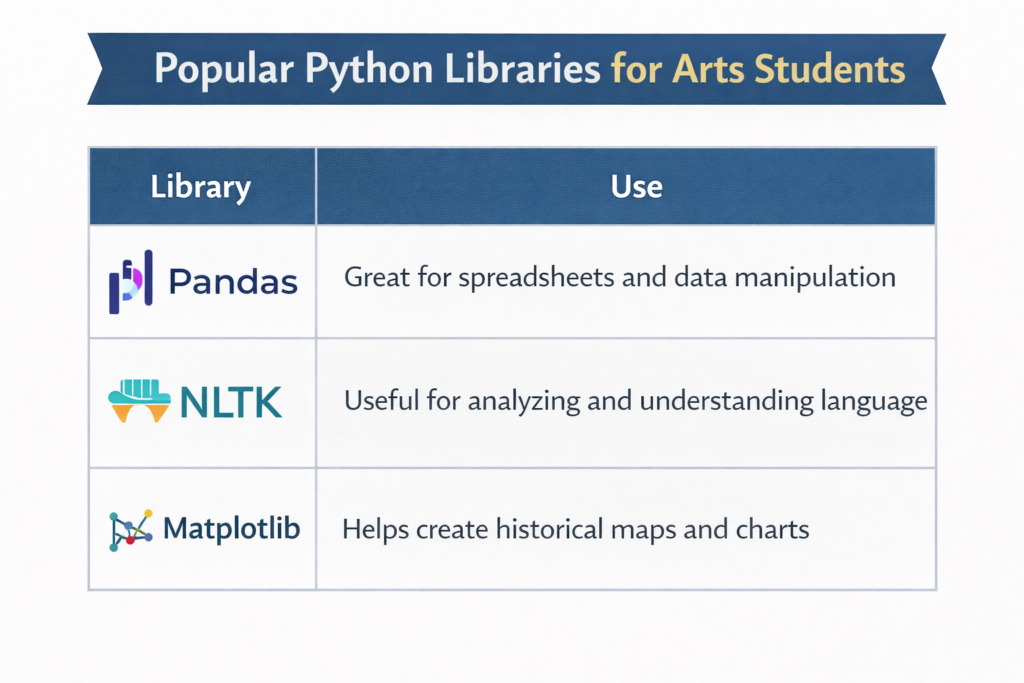
Data literacy also grants students the ability to visualize their findings. Standard essays are often limited by what can be described in prose, but many historical patterns are better understood through maps and charts. Python’s Matplotlib and Geopandas libraries allow students to create interactive maps that show the movement of trade goods, the expansion of empires, or the flow of migration. These visualizations make research more accessible and engaging for a global audience, helping complex academic ideas jump off the page and into the public consciousness.
4. Overcoming the Technical Barrier in 2026
While the benefits are clear, the transition to a data-literate mindset is not without its hurdles. Students often feel a sense of “imposter syndrome” when stepping into a computer lab. They worry that they aren’t “math people” or that they will break the software. The reality is that coding in the humanities isn’t about complex calculus; it is about logic and organization. It is about learning to structure a question in a way that a machine can answer.
The academic community has recognized this struggle, leading to a surge in interdisciplinary support. From “Coding for Poets” workshops to specialized tutoring, the resources are expanding. Many students find that once they overcome the initial fear of the terminal, they discover a new form of creativity. Writing a successful script is not unlike writing a perfect sonnet; both require precision, structure, and an understanding of how small parts contribute to a larger whole.
5. Future-Proofing Your Career in a Volatile Market
The job market for 2026 and beyond prizes adaptability. While a history degree develops excellent communication and research skills, adding “Data Analysis” or “Python” to a CV changes the trajectory of a student’s career. It opens doors to roles in digital archiving, data journalism, museum curation tech, and even high-level policy analysis. Employers are looking for people who can bridge the gap between human empathy and algorithmic efficiency. By mastering data literacy now, humanities students ensure they aren’t just consumers of technology, but architects of the digital future.
6. Ethical Data Handling and the Humanities Perspective
As AI and algorithms begin to dominate every aspect of life, the world needs humanities students more than ever—specifically those who understand data. Data is never truly neutral; it carries the biases of the people who collected it. A student trained in ethics, philosophy, and history is uniquely positioned to look at a dataset and ask: “Who is missing from this data?” or “What cultural context is being ignored?” Python is simply a tool, but when placed in the hands of someone trained in the humanities, it becomes a powerful instrument for social justice and historical accuracy.
7. Global Standards and the Universal Language of Code
One of the most overlooked benefits of Python is its role as a global academic bridge. Research papers produced in London can be easily replicated and expanded upon by scholars in Tokyo or New York because the code remains consistent. This transparency is vital for the credibility of the humanities in the 21st century. When a student publishes a paper on the sociological shifts in post-war Europe, providing the Python script used for the analysis allows other researchers to verify the findings. This moves the discipline toward a more collaborative, open-science model that benefits the entire academic community.
8. The Psychological Impact of Data Literacy
Beyond the professional and academic gains, there is a profound psychological benefit to becoming data literate. In a world where we are constantly bombarded by statistics and “big data,” feeling helpless in the face of numbers can lead to a sense of alienation. For a humanities student, learning Python is an act of reclamation. It is the realization that “the data” is not a mysterious force controlled by tech giants, but a collection of human records that can be interrogated, challenged, and understood. This empowerment shifts the student from a passive observer of the digital age to an active participant.
Conclusion: Embracing the Digital Renaissance
The integration of Python into the humanities is not an attempt to turn poets into programmers. Instead, it is a Digital Renaissance that provides scholars with a new set of brushes to paint a more accurate picture of the human condition. Data literacy does not diminish the beauty of a Shakespearean sonnet or the complexity of the French Revolution; rather, it provides a new lens through which we can view them at scale.
For the student sitting in a lecture hall today, the message is clear: do not fear the data. Embrace it as a partner in your research. While the transition from pen to code may feel daunting, the resources available—from peer mentorship to professional academic support—make this journey more than manageable. In the end, the humanities will always be about the human story. Python is just a faster way to read the chapters we haven’t reached yet.
Frequently Asked Questions
1. Why is data literacy important for non-science students?
Modern research often involves massive digital archives that are impossible to sort through manually. Data literacy allows students to use automated tools to find patterns, track historical trends, and back up their arguments with statistical evidence, making their findings more robust and credible.
2. Is Python difficult to learn for someone with no coding background?
Python is widely considered the most accessible programming language because its structure resembles natural English. It was designed for readability, meaning students can often understand what a script does just by looking at it, even before they start writing their own code.
3. How does “text mining” help in the study of history or literature?
Text mining allows a researcher to scan thousands of books or documents in seconds to find specific themes, sentiment shifts, or recurring phrases. It enables “distant reading,” where you can analyze the linguistic evolution of an entire century rather than focusing on just a few individual texts.
4. Will learning to code take time away from my core subject studies?
While there is an initial learning curve, the time saved in the long run is significant. Tasks that would normally take weeks of manual archival work can be completed in minutes, allowing more time for the deep critical analysis and creative thinking that define the humanities.
About The Author
Ella Thompson is a seasoned academic consultant and lead content strategist for MyAssignmentHelp. With over a decade of experience in higher education trends, she specializes in bridging the gap between traditional research methodologies and modern digital tools. Ella is dedicated to empowering students globally by providing actionable insights into academic success and professional development.

Looking for a reliable stp treatment plant solution? Trity Environ Solutions provides advanced sewage treatment plants designed for residential societies, industries, commercial buildings, and institutions with efficient water recycling and CPCB compliance support.
Really impressed with the security and the way they handle transactions. Everything feels safe and professional at kratonbetkr.
Best experience I have had in a long time. The site is stable and the rewards keep me coming back every day. Visit mulia77login
The odds here are way better than other platforms I have used. It is a game changer for anyone who knows how to play the long game. phstakeph
I’ve been trying a few different sites lately, but the experience here is surprisingly smooth. The payouts are fast and the interface is very user-friendly. Highly recommend r888bet for anyone looking for a reliable spot.
Very stable platform with a lot of exciting options. I feel safe depositing my funds here. Check out plataformapgwin for a secure bet.